


My role
Lead UX Designer
Company
Amazon
Scope
Search, product detail pages, checkout, and service discovery across heavy bulky commerce
Impact
Preserved service discovery and attach rates after Add-to-Cart moved to search
Many large purchases require more than just a product.
These services often determine whether a purchase is successful and the product is ready to use. Customers frequently consider them part of the buying decision rather than optional add-ons.
While leading UX design for Heavy Bulky Services at Amazon, I owned the service discovery experience across search, product pages, and checkout. My role involved coordinating across search, checkout, and services teams to ensure that services remained visible throughout the purchasing journey.
Heavy bulky commerce operates at meaningful scale.
This category represents roughly nearly 10 percent of Amazon’s total gross merchandise sales, accounting for approximately 25 billion dollars in product revenue and 200 million dollars in services revenue annually.
Customers could now add items to their cart without ever visiting the product detail page, which was the primary place where services were previously explained.
Because services are closely tied to these purchases, the moment when customers discover them matters.
In 2024 Amazon introduced a company-wide initiative to place Add-to-Cart directly within search results.
The goal was simple. Reduce friction and allow experienced shoppers to purchase faster.
At the time, roughly 30 percent of customers were already adding items to their cart directly from search. Enabling this behavior directly within the results page improved speed and reduced unnecessary navigation.
For many retail categories this was a clear improvement.
For heavy bulky purchases, it introduced a new design challenge.
Before this change, customers typically followed a consistent purchase path.
They searched for a product, opened the product detail page, and then added the item to their cart.
That step mattered because the product detail page was the primary place where services were surfaced and discovered by customers.
Installation, assembly, haul-away, and room-of-choice delivery were all introduced in that environment.
After Add-to-Cart moved into search, customers could add products directly from the results page without ever visiting the product detail page.
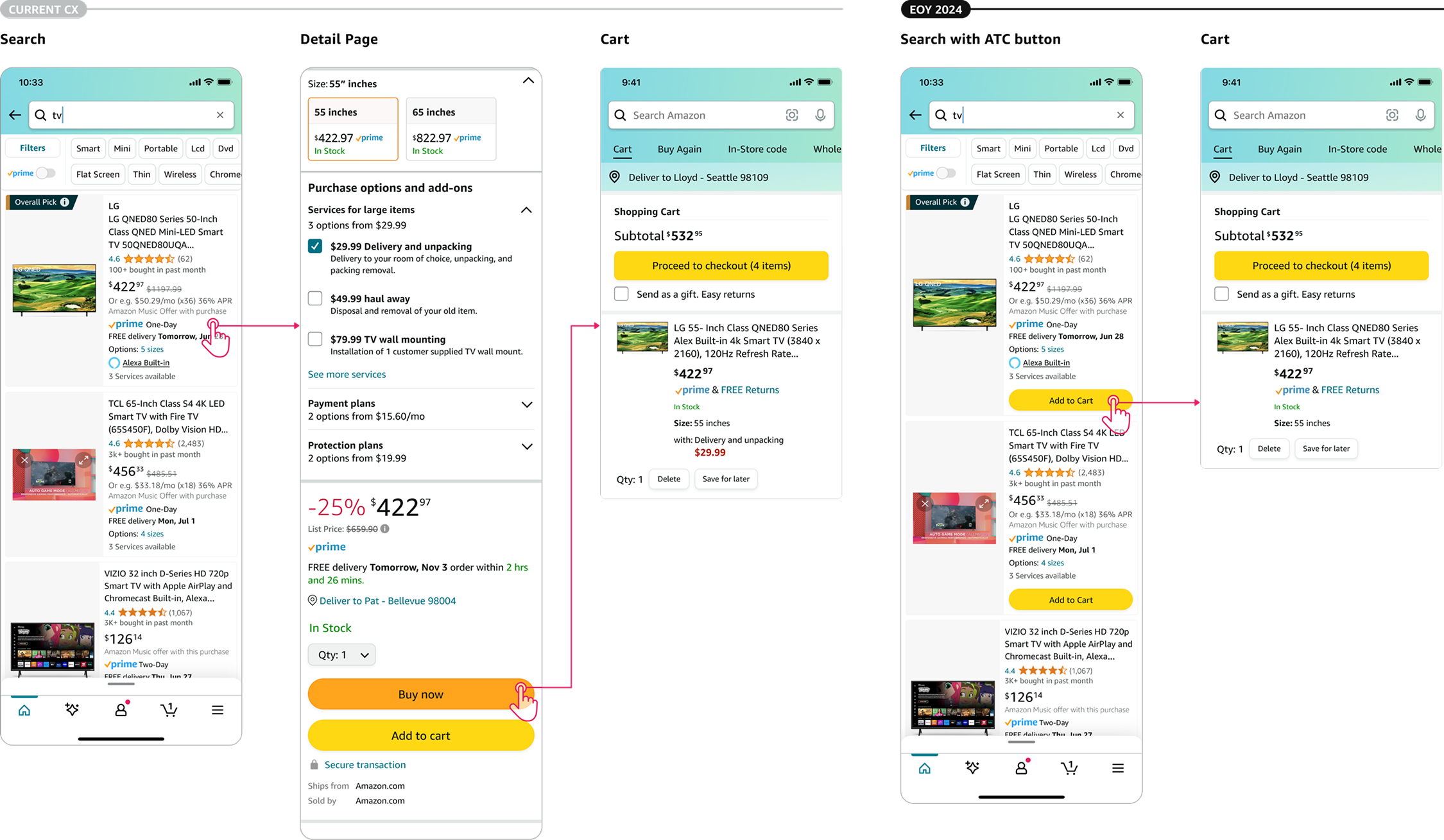
Services technically still existed in checkout. However checkout is optimized for speed and completion, not discovery. Optional services are easy to overlook when the primary task is finishing a purchase.
This created a real risk.
Customers could complete a heavy bulky purchase without ever realizing that services were available.
User research confirmed that service awareness was already lower than expected.
Heavy bulky purchases often follow long and nonlinear research paths. Customers frequently begin with Google searches, compare retailers, and spend up to two weeks evaluating options before committing.
They also tend to purchase related items together. A washer is often purchased alongside a dryer. Televisions frequently require mounts, sound systems, or installation services.
Despite this complexity, one comment appeared repeatedly in customer interviews.
“I didn’t know Amazon offered services like installation.”
The Add-to-Cart change risked reducing service awareness even further unless services were surfaced earlier in the journey.
The core design question became:
How can services be surfaced when customers add products directly from search?
The solution needed to balance three principles.
Discoverability
Clarity
Scalability
The design also needed to operate within several system constraints.
Because of these constraints, the solution could not rely on a single surface. The design needed to balance visibility and performance across the search experience.
I explored several directions that increased service visibility at different levels within the search experience.
The first concepts reused existing design system surfaces such as expandable sections and horizontal add-on carousels.
These modules appear after a customer adds a product to their cart from search.
Advantages
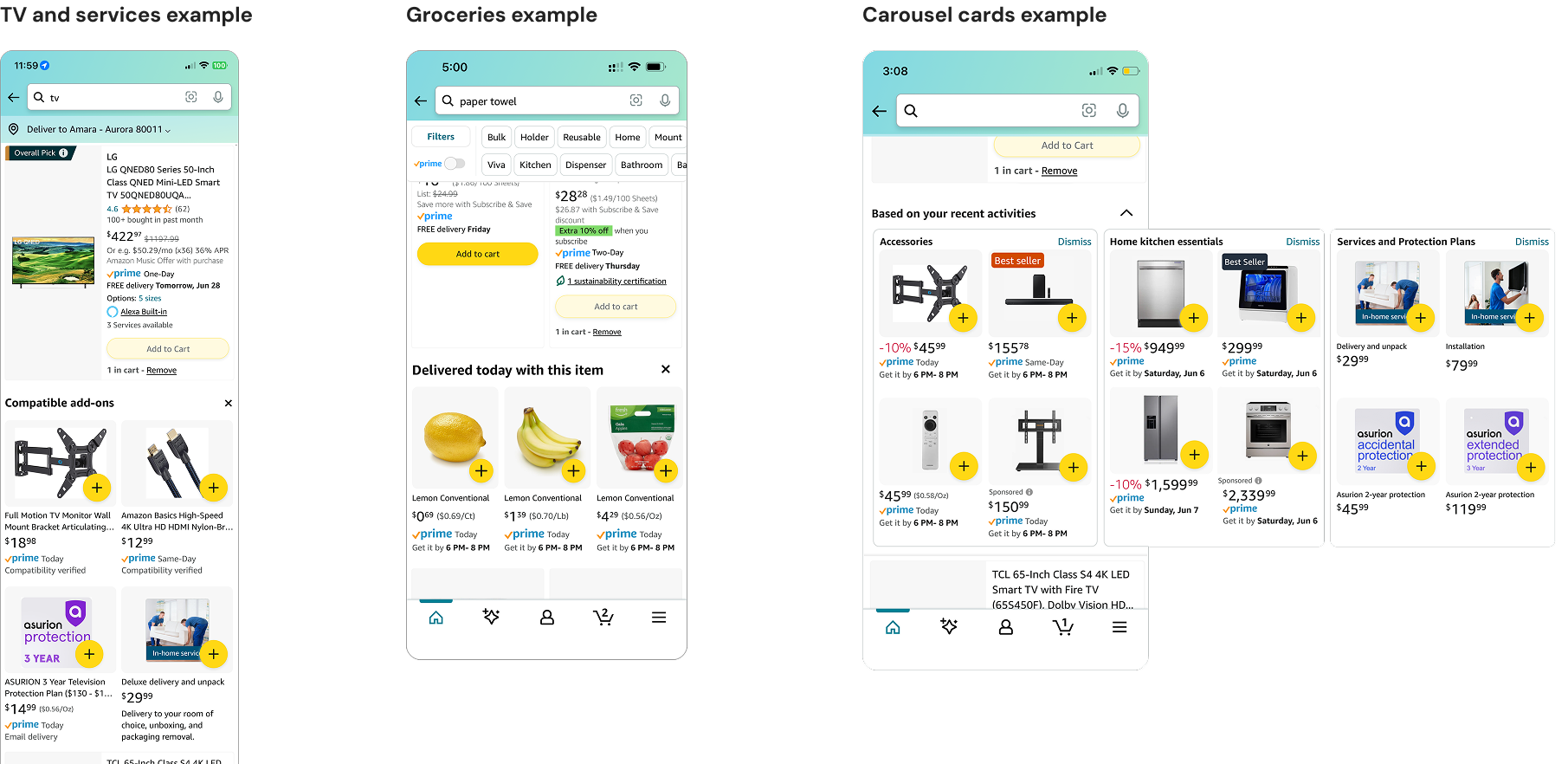
However the pattern revealed an important limitation.
Presenting services alongside accessories caused them to appear like optional add-ons rather than operational services. This reduced their perceived importance.
These patterns worked well for low-price purchases where customers quickly add complementary items. Heavy bulky products and services are infrequent, high stakes purchases and often require more context and confidence before committing to a buying decision.
The next direction explored separating services from product add-ons.
After a product was added from search, two modules could expand.
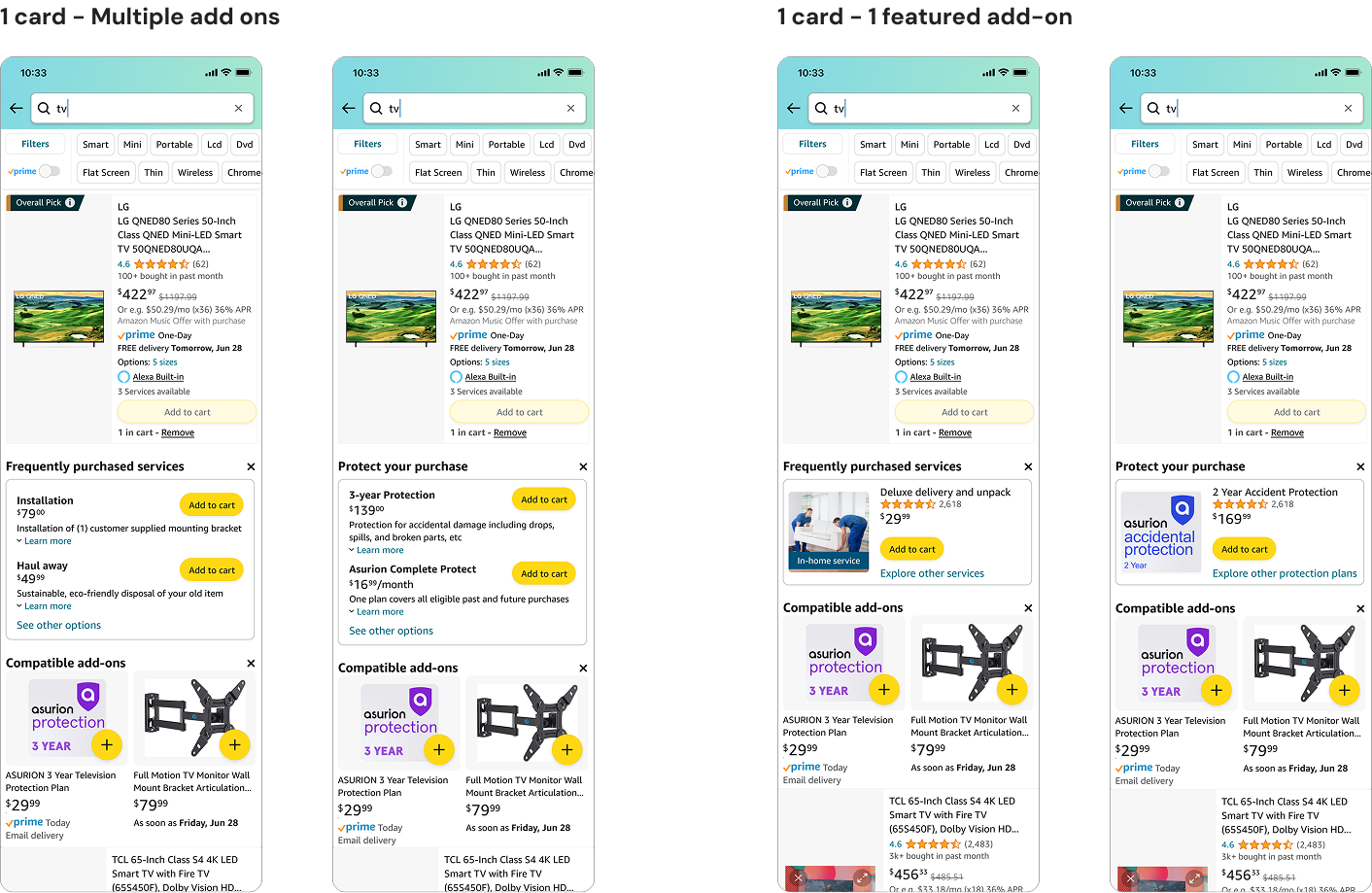
Separating these elements improved discoverability and helped customers understand the difference between services and physical goods.
The tradeoff was visual weight. Expanded modules consumed significant vertical space and some users interpreted the module as an upsell rather than helpful guidance.
Another exploration tested whether services should appear more prominently within the search interface itself.
Amazon’s search experience is intentionally minimal, with most elements appearing on a white background. Introducing colored cards created visual contrast that immediately drew attention.
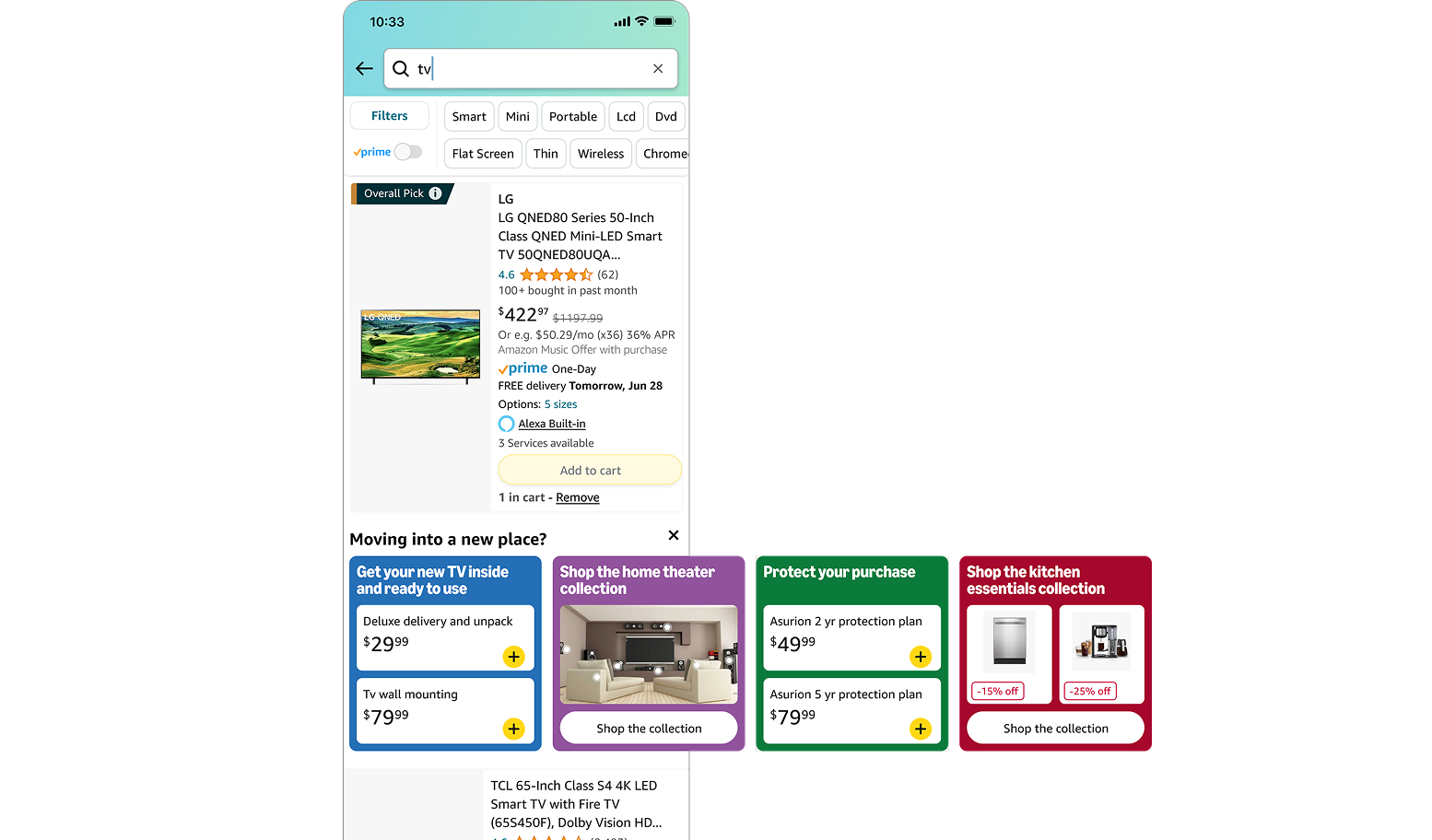

These cards could highlight curated experiences such as:
Rather than appearing as add-ons, services became entry points into guided purchasing journeys.
This approach better matched how customers plan large purchases that involve multiple components.
A related challenge was explaining services through text alone.
Installation, assembly, and haul-away services often involve operational details that are difficult to understand through bullet points.
To address this, I explored embedding short-form video directly within service cards.
Instead of reading descriptions, customers could watch a short demonstration of how the service works.
Short-form video formats have become familiar through platforms such as YouTube Shorts, Instagram Reels, and TikTok. Applying this pattern to commerce helped customers understand services more quickly.
Video modules introduced new considerations including production cost, loading performance, and accessibility.
The Add-to-Cart platform change created a risk that customers could bypass the moment where services were traditionally discovered.
The goal of this work was to ensure that faster search-based purchasing did not reduce awareness of services.
After launch we observed:
Due to confidentiality, I cannot share exact metrics. However, internal reporting showed that service engagement increased after launch and service sales remained stable despite the shift toward Add-to-Cart behavior directly from search.
This indicated that the design successfully preserved service discovery even as purchasing behavior evolved.
Designing within large commerce systems often means balancing competing goals.
In this case the challenge was preserving the speed benefits of search-based purchasing while still helping customers understand the services that make those purchases successful.
This work reinforced several lessons.
A longer write-up of this project is available on Substack:
Designing Service Discovery When Add-to-Cart Moves to Search