Background
Hospitals manage incidents every day, from medication errors and equipment failures to workplace violence.
Health systems need to identify what happened, investigate it, coordinate the right response, and prevent the same problem from happening again.
As part of an AI enablement engagement with an Upstate New York health network, I led the product strategy, design, and development of an AI-assisted incident management system.
The goal: identify high-priority incidents faster, reduce investigator workload, and improve patient and workplace safety.
What I delivered
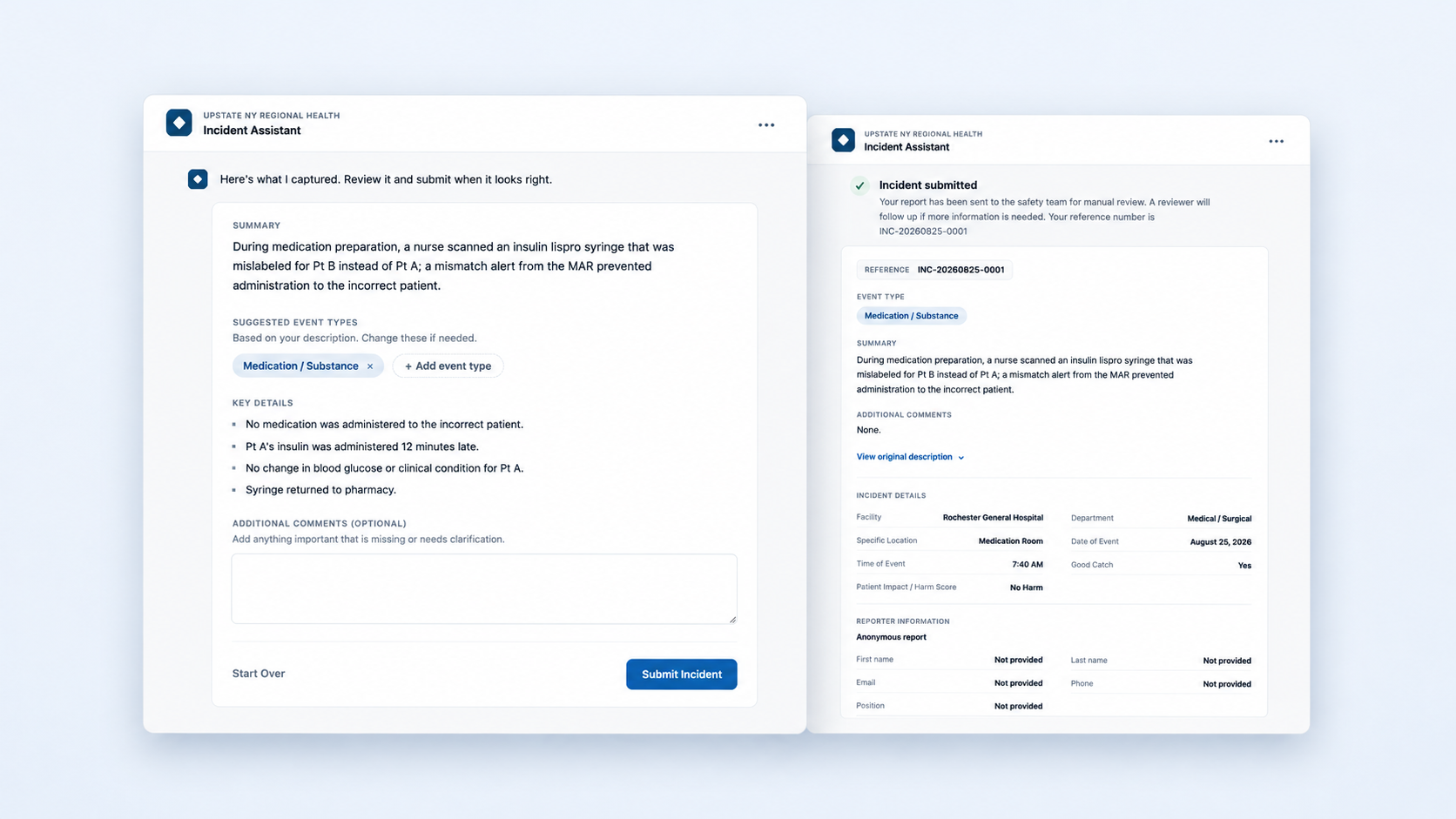
From 4+ mins to under 1.5 mins for a busy hospital worker to report an incident
- Clearer incident identification
- Working AI-powered prototypes
- Incident management strategy and roadmap
- Design system tokens & components
The Summary
I began by working closely with Patient Safety Operations, and Incident Investigators to map out the entire workflow from initial incident submission to final reporting and handoff to claims or escalation to VP review.
I studied how the work actually happened, where cases stalled, and why investigators were overwhelmed. This required a systems-thinking view of the entire process. I found a process that was slow and heavily manual.
- Time-pressed employees submitted reports through cumbersome portals. 4+ pages, 4+ min average completion time
- Investigators reviewed every case with no system prioritization. 2+ month investigation time
- Cases moved informally between teams while remaining open in the system
The Strategy
After examining the full process, I chose initial intake as the first place to apply AI.
Every incident passes through intake. It is also where the person closest to the event still has the clearest context. Once an incomplete or unclear report enters the system, every later step becomes harder. Investigators must reconstruct what happened, determine urgency, find the right people, and decide where the case belongs.
Starting later in the process would mean repairing poor information after context had already been lost. I chose to improve the information at its source.
My strategy was to help employees report incidents clearly and help investigators understand them earlier. This could reduce manual work and support better prioritization, coordination, and prevention without requiring the hospital to replace its entire process at once.
Improving report quality without adding complexity
Early testing showed that employees often left important context out of incident reports. I defined the minimum information needed to begin an investigation and support useful AI analysis, then considered how to help employees provide it.
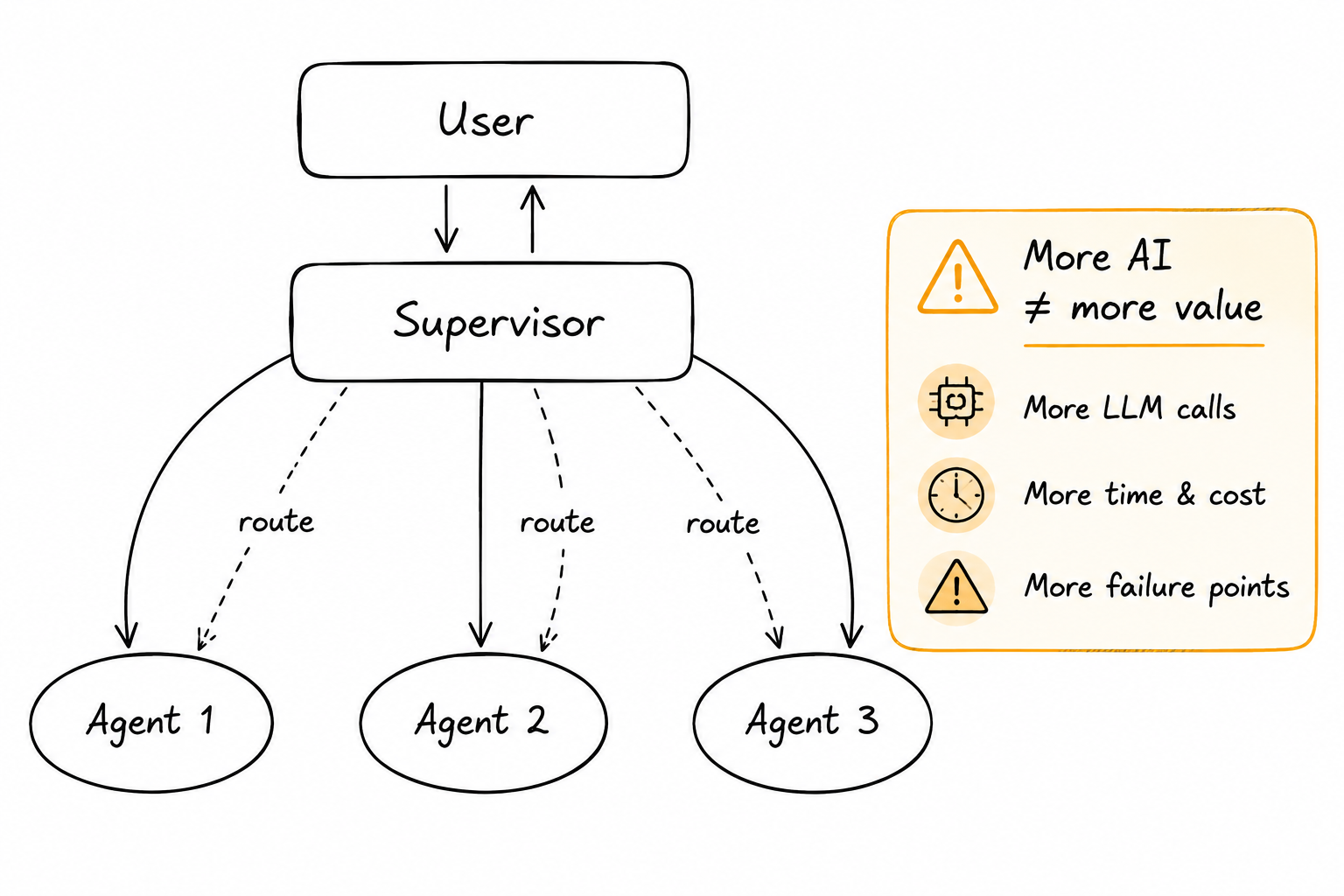
An AI conversation could gather missing details afterward, but would add model calls, conversation state, follow-up logic, and more opportunities for error. I chose a short list of guiding questions alongside the narrative field so employees could include the necessary information the first time.
This made a dramatic difference in narrative completeness during subsequent testing, with little engineering overhead and no conversational workflow to maintain.
AI then organizes the description into a structured draft, which the employee reviews and corrects before submission.
Watch on YouTube ↗︎Guardrails for responsible AI
The design allows anyone to submit an incident report anonymously, in line with legal requirements.
Sensitive information is captured separately and kept out of the AI workflow. The system uses local or approved models so protected health information stays within the hospital’s system.
Checks keep the model on task to prevent hacking or prompt injections.
Watch on YouTube ↗︎Uncertainty, failure, and recovery
Thinking beyond demo happy paths
If the AI fails or becomes unavailable, the incident can still be submitted and the investigation can begin.
Watch on YouTube ↗︎Cost and efficiency
Complexity needs to earn its place.
Not every product requires several LLM agents.
The workflow didn’t need an autonomous agent. AI could create more value by reading each report once, organizing the key information, and preparing it for human review.